SOFTENER
Hardness management
Understand the vessel, resin, controls, regeneration and water-use context.
Softener guide →Commercial water-treatment equipment can work as a train of distinct components. One stage may manage hardness, another may address a specific water-quality objective, and another may support a point-of-use application. An equipment inventory lets a facility describe its system more accurately.
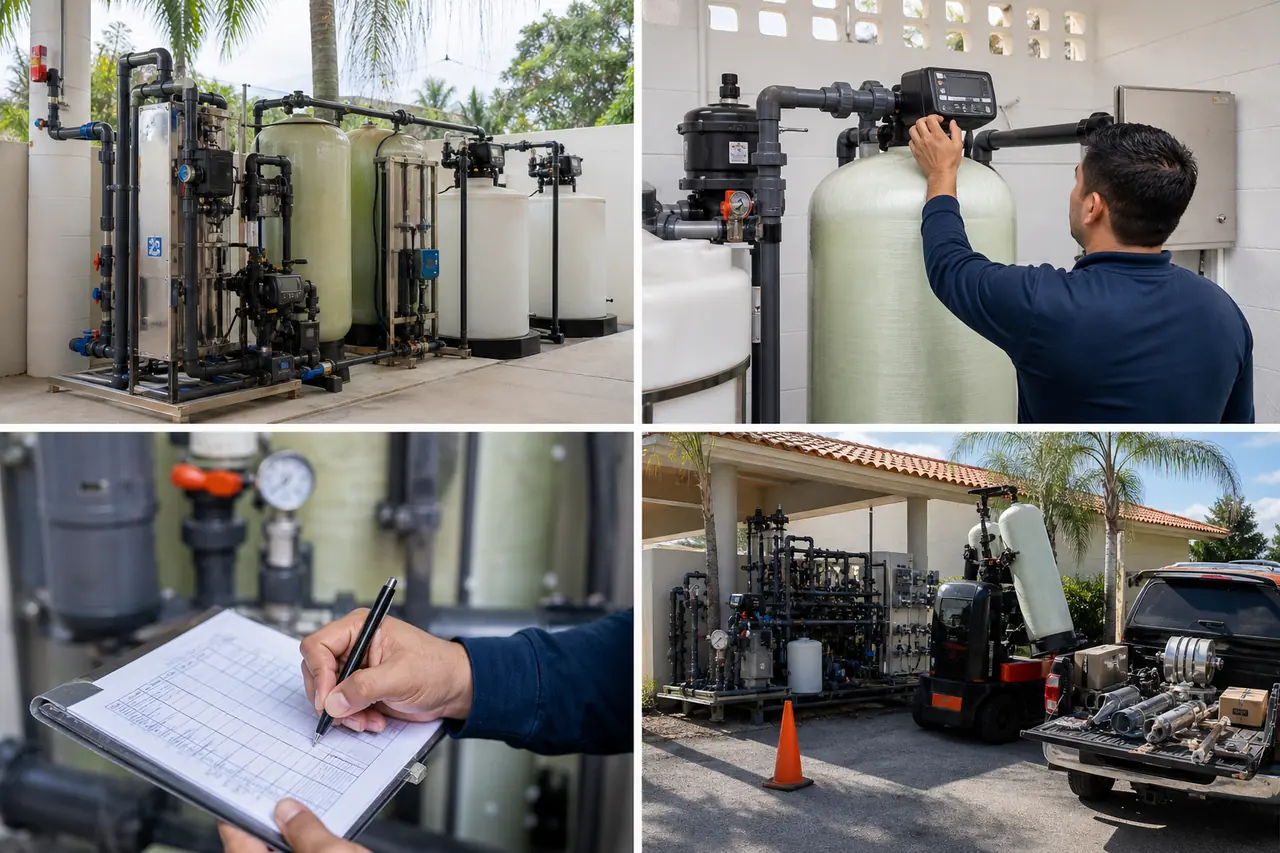
Pretreatment / sediment: often designed to manage particulate load before downstream equipment.
Carbon: may be included for specific adsorption objectives.
Softening: commonly used to reduce hardness minerals via ion exchange.
RO / DI: may serve a specified point-of-use or water-quality purpose.
The diagram is educational. It is not a specification for any property.
Understand the vessel, resin, controls, regeneration and water-use context.
Softener guide →Record the whole system—pretreatment, membrane, controls and performance information.
RO guide →Clarify the high-purity application, treatment train and existing equipment record.
DI guide →Consolidate the property’s equipment and service information before pursuing a scope.
Planning guide →